

My phone loads the video instantly. My home Wi Fi still spins.”
— unknown, Bengaluru apartment resident
The internet here grew up on phones. It never grew underground.
India crossed a billion broadband connections almost entirely on the back of cheap mobile data, a genuine achievement. But fewer than 5 percent of those connections run on fixed wireline, the opposite of nearly every comparable economy. As AI tools, telemedicine, and digital governance start needing steady, high capacity links rather than a phone signal, that gap stops being a quirk. A rural clinic streaming a specialist consult cannot depend on a cell tower that slows every time three neighbours join a video call.
THE SPEED PARADOX
Home Broadband Loses To Phones
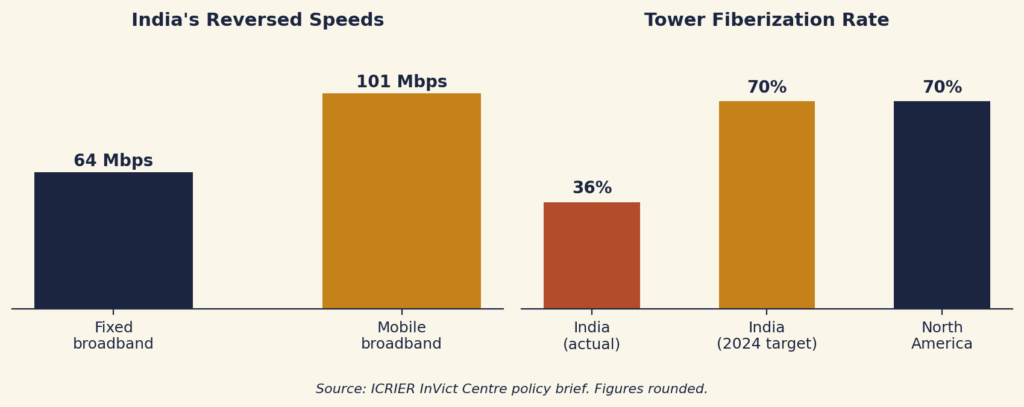
India’s average fixed broadband speed is about 64 Mbps, while mobile clocks around 101. Nearly everywhere else, fixed lines beat mobile by two to four times. Part of the reason is price: a home broadband plan here costs roughly three times as much as mobile data relative to income, double the global norm. Faced with a slower, pricier product, most households simply skip it, which starves operators of the demand needed to justify upgrading the network.
THE MONEY TRAP
Funds Collected, Never Spent
BharatNet promised fibre to every village starting in 2011. By September 2025, only about 2 lakh of a targeted 6.5 lakh villages were connected. The bottleneck is not willingness but plumbing. Telecom operators pay a 5 percent levy into the Digital Bharat Nidhi, but that money first lands in the Consolidated Fund of India and needs a fresh budget allocation before release. Over 1 lakh crore rupees now sits unused, waiting on a process never built for speed.
THE GLOBAL PLAYBOOK
Borrow The Shared Network Model
Chile funded a national fibre backbone through reverse auctions and forced wholesale access, so any ISP, big or small, could use the same cables. Singapore separated who owns the fibre from who sells the broadband, so no single company favours its own retail arm. India’s two largest telcos control 75 percent of the market and mostly build separate, duplicate networks in the same profitable neighbourhoods. Mandatory wholesale access, tried elsewhere, remains optional here.
KEY TAKEAWAYS
- Speed is reversed. India is one of the few countries where your phone beats your home broadband, 101 Mbps against 64.
- Fibre feeds the tower. Only 36 percent of cell towers have fibre backhaul, well short of the 70 percent target, so even 5G runs slow.
- Funds sit idle. Over 1 lakh crore rupees meant for rural connectivity is stuck between the telecom levy and the budget process.
- BharatNet lags badly. Just over 2 lakh of a targeted 6.5 lakh villages are connected, years behind schedule.
- Other countries shared pipes. Chile and Singapore mandated wholesale fibre access so no single operator hoards the network.
- Watch the messenger. The report backing these fixes comes from a centre partly funded by Vi, a direct beneficiary of the reforms it proposes.